


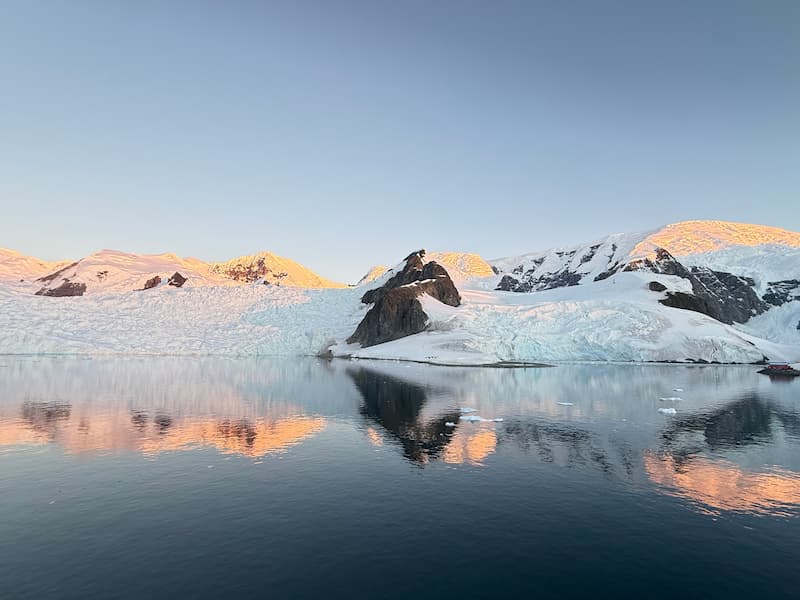
This past March, I set sail aboard Atlas Ocean Voyages’ World Traveller to Antarctica—one of the most compelling and remote destinations on the planet. During the sailing, I had the opportunity to speak with Expedition Leader Ekaterina Uryupova—an insightful conversation that offered a deeper perspective on the Antarctic experience.
Having worked in both Antarctica and the Arctic for over 10 years, Uryupova knows a thing or two about the Polar regions. Additionally, she holds a Ph.D. in Environmental Sciences, with a focus on marine biology, oceanography, climate impact on ecosystems and interdisciplinary research efforts in environmental protection, and has interned at the Secretariat of the Antarctic Treaty in Argentina and at the Smithsonian Institution in the U.S. As if those credentials weren’t weighty enough, she is currently a member of the Association of Polar Early Career Scientists (APECS) and Permafrost Young Researchers Network (PYRN).

In my conversation with her, I began with a central question: How do you showcase a destination as extraordinary as Antarctica to curious travelers while ensuring its protection?
“The first time I came here in 2008, I was amazed by the beauty and the characteristics of this continent. Since [then], I decided that my life should be connected to the Polar regions, so I have been growing that passion, and I want to grow this passion in the hearts of other people,” Uryupova tells Recommend.
She says that after her initial visit to Antarctica, she started to look for other ways to return, through scientific projects, which allowed her the opportunity to work at different stations, on breakers and with international organizations. Uryupova realized that she preferred being in the field because she could see the changes happening up-close and she could explain what was happening in the environment. “So,” she says, “I decided for myself that scientists should spend more time in the field to see the changes and then give this description in detail to the general public.”
For her, it’s important that scientists share the knowledge and speak in layman’s terms to the general public. Relaying the “trends, big changes, global changes with everyone else. For me it was a reference point and I decided to work for other companies or other organizations that are not truly related to pure science.”

She got this opportunity after being invited to be a lecturer on board a cruise ship, which she thoroughly enjoyed. So much so that, as she says, “she’s still here.”
When I asked her specifically about working with Atlas Ocean Voyages, Uryupova says that since she has worked with other operators, she has something to compare the cruise line with and can confidently say that Atlas’ “beautiful fleet of expedition vessels are easy in terms of operation. So, as an expedition leader, I can tell you that we can easily start the operation [shore excursions] very fast, prepare the Zodiacs, and approach some interesting narrow, shallow locations, not using the physical anchor, using GPS positioning.”
This last bit she says is important, because the expedition team, the captain and the cruise line are always making sure that the fragile ecosystem is protected. She notes that it’s important to relate the system’s fragility to the guests, and she sees how the line is focused on sustainability that’s guided by expertise.
Uryupova says that the people who work for the company, the captains, for example, have “many years of experience working in the Polar regions…. We learn together; it’s a journey and we learn, work and share this knowledge with guests.”
Despite rising cruise interest to Antartica, visitation levels remain, in Uryupova’s view, too low to significantly impact the environment.
“Antarctica is still a very remote and quite inaccessible continental destination. It has some specifics related to safety, distances, time to be spent in the field, so we have some limitations for many visitors,” she says.
She tells us that the passengers who visit the Polar regions understand that this is a “special type of travel.” She adds that since the season is a short one, from November to March, “nature is able to heal and recover” during the rest of the year. And she reminds me that we are only touching a very small part of Antarctica.
She stresses that the team and crew work diligently to showcase the destination in the “most efficient and environmentally friendly way such as speed limitation in well-protected areas, the speed of Zodiacs when approaching wildlife, the use of light at night so as not to blind birds, etc.”
And bringing guest lecturers on board during sailings is also important, she notes, as guests can ask questions and gain more insight on a broad swath of topics related to Antarctica and beyond.
For example, during my sailing, which took place in March, the guest lecturers touched on two vastly different topics: composting and its positive effects on the environment and viewing the world through a more intentional photographic lens.

And when it came to traveling to Antarctica in March, which wraps up the season, Uryupova tells me that it’s “a beautiful time” to sail here. During this time, “there’s less snow cover at the landing sites, milder climates and you can do stargazing,” which differs from the rest of the season as from late October to late February, passengers will be experiencing the Midnight Sun.
“Every day is a new page, and visitors will write their own book of Antarctica,” says Uryupova. “ I think every single visitor to Antarctica should be proud of this opportunity because it’s not easy to get here; time-wise, money-wise as well. I think this is the best way to learn about nature because this is the global laboratory.”
For the first-hand review of sailing in Antarctica aboard Atlas Ocean Voyages’ World Traveller, click HERE.


