


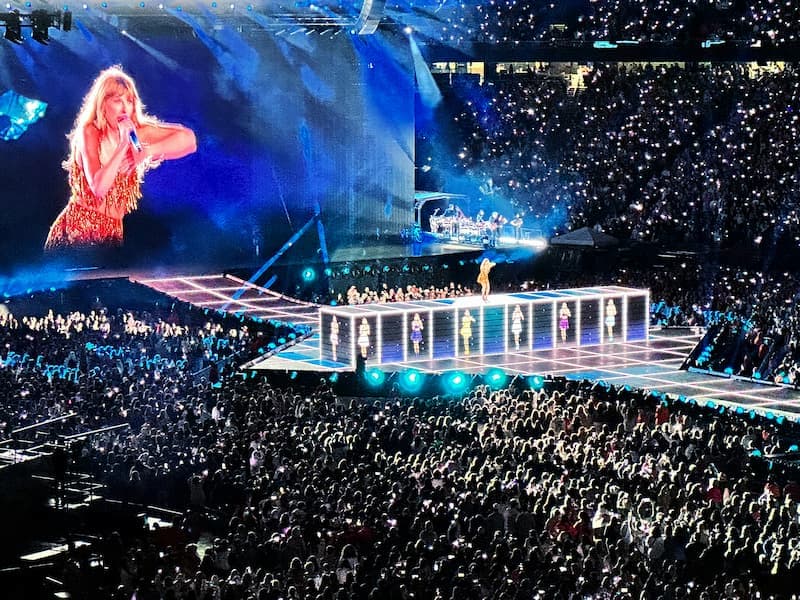
Taylor Swift’s “Eras” tour grossed more than $1 billion in 2024 and drew millions of “Swifties” to destinations all over the world to hear her music—but also to eat, drink, and play tourist during their visit.
A U.S. Travel Association report found that during the “Eras” tour, Taylor Swift fans spent an average of $1,300 each during their stay in U.S. host cities. “That amount of spending is on par with the Super Bowl, but this time it happened on 53 different nights in 20 different locations over the course of five months,” the report noted.
Taylor Swift Takeover
During Swift’s Nashville “Eras” shows, for example, local hotels enjoyed a 90 percent occupancy rate—33 percent higher than on shouldering, non-show days—an average daily rate (ADR) that was 51 percent higher, and a 101 percent RevPAR premium, according to a report from STR. Philadelphia, Boston, Dallas and Houston were among the other cities that saw significant spikes in hotel performance metrics during Swift’s local engagements.
Flight bookings also reflect demand for shows like Swift’s. United Airlines, for example, reported that flight demand rose 25 percent to cities where Swift was scheduled to perform, both domestically and internationally.
The combined economic impact has been dubbed the “Taylor Swift Effect,” but it’s not limited to Swift alone: shows by major stars like Bad Bunny, Pink, Beyonce and Coldplay also provide a major influx of visitors with time on their hands and money to spend.
For example, a pair of 2024 Pink shows in Townsville, Australia—the result of a decade-long lobbying campaign to bring the performer to the small city in northern Queensland—generated an estimated $30 million in revenues, according to the Australian Broadcasting Corporation.
According to the market analysis firm Technavio, the global live music market is expected to grow by $18 billion between 2025 and 2028. Allianz Partners USA’s annual Vacation Confidence Index found that 63 percent of Americans plan on experiencing at least one ticketed event this year, with 29 percent saying they would travel to a major destination to see a show.
The trend is especially strong among younger travelers, the report noted.
“As we have seen with major concert series, like Taylor Swift’s ‘Eras’ tour, Americans are traveling both domestically and internationally to attend events,” according to Allianz. “Over half of travelers are expected to attend at least one ticketed concert or event this year, and the proportion of individuals attending three or more concerts, festivals or events has risen by five points this year.”
Sensing the trend, airlines and tour operators are creating special packages for “gig-tripping” fans traveling to shows. Hospitalitynet, for example, advises hoteliers to create targeted marketing campaigns to attract music fans, as well as encourage concertgoers to extend their stays.
Nor is the trend limited to musical performers: gig-tripping also applies to major sporting events and even conventions like Comic-Con.
For travel advisors and their clients, the downside is that hotels, which are wise to the trend, are increasingly using surge pricing to maximize profits during major events, resulting in higher costs for travelers. Booking early remains a potential cost-saving option and, in the case of flights, a near-necessity: United Airlines noted that demand for seats was 20 percent higher than normal during Taylor Swift shows, with sales especially brisk on weekends.
While the average cost of a concert ticket hit a record $135.92 in 2024, according to Pollstar, in some cases it makes more economic sense for clients to travel to a venue where prices are lower rather than paying top dollar in a nearby city.
For example, a ticket to a sold-out concert at Madison Square Garden, which sells on the secondary market for a huge markup, might be available at a fraction of the cost in Montreal, a 6-hour drive north, where it’s illegal to resell tickets over face value.


