


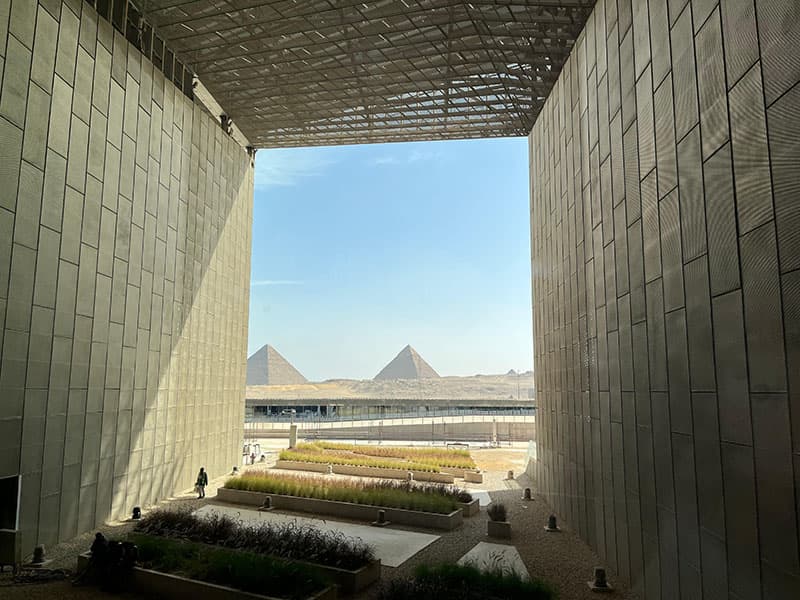
With the long-awaited Grand Egyptian Museum now open, Egypt is entering a new phase in its tourism strategy—one focused not only on headline attractions, but on longer stays, diversified itineraries and improved access across the country. We sat down with Sherif Fathy, Egypt’s Minister of Tourism and Antiquities, during USTOA’s Annual Marketplace & Conference, to learn more about the changing travel landscape in one of the world’s most iconic destinations.
Recommend magazine: With the Grand Egyptian Museum finally open, what early indicators are you seeing in terms of visitation, traveler sentiment and demand? And how do you anticipate the museum reshaping Egypt’s tourism landscape over the next couple of years?
Sherif Fathy: The Grand Egyptian Museum is something we’re very proud of. It’s an experience on its own because it’s not like any other museum. The size is not the only unique thing about it—the contents and the way the artifacts are displayed are equally important.
For the first time, the museum contains the entire collection of King Tut in one place. All 5,000-plus artifacts are under one roof for the first time, which is extremely unique. You really have to see it to understand.
Today, the Grand Egyptian Museum is being visited by an average of about 12,000 tourists per day. In addition, we’ve had four million additional tourists visit our archaeological sites and museums this year.
We expect the Grand Egyptian Museum to contribute in two ways: First, by increasing the number of nights tourists stay in Egypt. Second, by serving as a destination in its own right for culture and archaeology lovers who come specifically to visit the museum.
Recommend magazine: And of the four million additional visitors, how many are coming from the U.S.?
Fathy: We don’t have data on visitation to the museum by nationality because we don’t profile visitors that way. But U.S. tourism to Egypt overall has increased by about 20 percent—actually closer to 21 or 22 percent. Americans are among [Egypt’s] top 10 fastest-growing source markets.
With more awareness of what Egypt can offer beyond the traditional itineraries—Aswan, the pyramids and similar highlights—I think the number of U.S. tourists will increase dramatically.

Recommend magazine: Are you seeing any demographic shifts from the U.S.?
Fathy: Not a significant change. The primary age bracket remains roughly 45 to 60.
One reason we’re here [at the USTOA conference] is to talk about the unmatched diversity of Egypt. Egypt has a lot more to offer than the traditional tours sold in the U.S. market, and we need to explain this to tour operators and the public.
For example, there’s no country in the world where you can combine a beach experience with one of the most important monasteries in the world, St. Catherine’s. From Sharm El Sheikh, you can enjoy beaches, snorkeling and diving, then drive just two hours to the [sixth-century] St. Catherine’s Monastery, which is still active today.
You can also combine a Nile cruise with visits to sites along the Holy Family Route [the route Jesus, Mary and Joseph took]. The Holy Family traveled more than 3,500 kilometers [2,175 miles] across Egypt, and 25 sites have been identified. A Nile cruise from Cairo to Luxor allows travelers to visit some of these locations along with major archaeological sites.
Once in Luxor, you can go to Hurghada to enjoy the beaches. The North Coast is one of Egypt’s newest and fastest-developing destinations along the Mediterranean—it’s the whole shoreline from Alexandria all the way to the Libyan border. There are huge projects underway there, including a new airport; we currently have three airports there and we’re adding the fourth one. Last year, we saw a 520 percent increase in charter flights going to the El Alamein area.
[Travelers can also go] south into the desert to Siwa, where we have a combination of wellness and ecotourism hotels without electricity.
Recommend magazine: What does airlift from the U.S. look like right now? How easy is it to get to Egypt?
Fathy: Currently, there are two ways to get there. EgyptAir flies to three U.S. destinations: [Newark], Washington, DC and New York [JFK]. [This year, EgyptAir is adding Cairo-Los Angeles in May and Chicago-Cairo in June].
Recommend magazine: Do you see any challenges with the U.S. market right now?
Fathy: The main challenge is connectivity—the number of flights. Other than that, no.
I also see more reliance on travel advisors. Despite all that’s happening around us, [in 2024], we grew by 6 percent and in 2025, it’s going to be 20 to 21 percent.
Recommend magazine: Can you share more about the high-speed rail network and how it will enhance access to coastal regions?
Fathy: We’ve begun testing parts of the monorail…. The plan is to connect east to west and north to south. It will be a great facilitator for tourism.
[I think] by the second quarter of 2026, the northern segment should be operational, with additional connections coming by the end of the year. For example, travel time from Cairo to Aswan will be reduced from 10–12 hours to about four hours.
Recommend magazine: In terms of sustainability in Cairo, what initiatives should travel advisors be aware of, especially as clients increasingly ask about this?
Fathy: If you visit Cairo today—we’ve finalized many projects, such as bridges and tunnels, and we’ve moved the government ministries to The New Capital [a purpose-built city east of Cairo that houses government functions]—you’ll immediately notice reduced traffic.
The Green Cairo 2030 project includes waste treatment, electric buses, water treatment and supplying archaeological sites and museums with green energy. The Grand Egyptian Museum itself is carbon neutral.

What’s Trending
- Egypt, as of 2024, has approximately 1,200 hotels, with a capacity of around 200,000 hotel rooms—from five-star to budget-friendly. The destination’s first art hotel, the 283-room Hyatt Centric Cairo West, has opened near the Grand Egyptian Museum. IHG will add two Cairo hotels (2026 and 2028), while the 500-room CairoHouse (a Marriott Autograph Collection property) and Four Seasons Hotel Luxor (slated for a 2027 opening) are underway
- Egypt aims to attract 30 million international visitors by 2030
- The country is known as a wellness hub, with mineral springs found across the country; popular spots include Siwa, Bahariya and Kharga Oases, while Aswan offers holistic retreats like Kato Dool Wellness Resort and The Zen Wellness Resort
Did You Know?
- Egypt is home to seven UNESCO World Heritage Sites—from the Pyramids of Giza to the Nubian Monuments
- Egypt’s 1,801 miles of coastline stretch along the Mediterranean Sea to the north and the Red Sea to the east
- The Red Sea hosts over 1,200 species of fish and offers diving and snorkeling along its coral reefs
- U.S. visitors to Egypt need a visa. The country offers an eVisa system, allowing travelers to apply online before departure


