


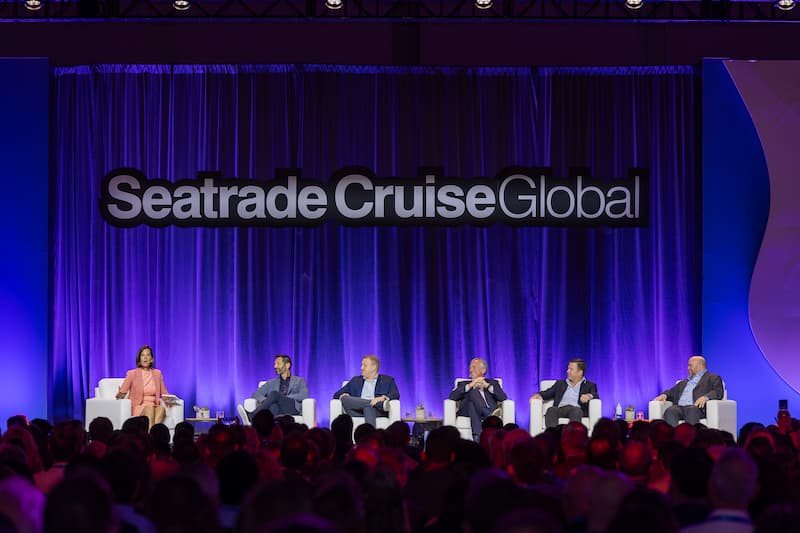
“We are strong, we are growing, we are resilient, we are better than ever.” CLIA President & CEO Charles “Bud” Darr is enthusiastic about where the cruise industry stands today. Addressing the attendees that filled the Miami Beach Convention Center’s Grand Ballroom for the State of the Global Cruise Industry Keynote during Seatrade Cruise Global 2026, Darr’s overall message focused on the increasing popularity of cruising.
2025 saw 37.2 million cruise guests—that, said Darr, is a “substantial increase from 2024, and it shows a continuing growth pattern.” He added that by the end of this decade, “we expect to have 40 million guests, and the intent to cruise is higher than ever. Our survey now shows close to 90 percent intend to cruise. When it comes to new to cruise, we have one-third still under the age of 40.”
Adding to that is the cruise sector’s global economic impact—$198 biillion, with 1.8 million jobs providing $60 billion in wages. “Think about that,” said Darr. “That’s fantastic for an industry that has a few hundred ships. There’s lots of room to grow. We’ve just scratched the surface of the potential market that’s out there, the international global tourism. We’re about 2 to 3 percent of it in when you take it into its context. Not that we should ever be 70 or 80 or 90 percent, but there’s a lot of room to still grow within that market and satisfy the demand we know is out there with better and better offerings and more and more responsible operation.”
That untapped potential is reflected in how the industry is evolving—both in fleet composition and in the types of experiences today’s cruisers are seeking. “We have a diverse fleet,” continued Darr. “The existing fleet is about one-third small [ship], one-third medium, one-third large. The order book is about the same, and we see the luxury sector and expedition growing.
“I think as a new generation of cruisers have somewhat different values and are willing to spend money on somewhat different experiences than in the past, the industry is evolving to satisfy that need as well as the existing customer base,” pointed out Darr. “We’re also finding a remarkably higher level of people that have never cruised before that really want to. And I think that means our message is getting through. And I think that the good work that everybody’s doing, particularly when it comes to social responsibility and being sustainable in our operations and being good partners in the communities where we serve, is starting to break through well in the public domain.”
Darr’s comments set the tone for a broader industry conversation that followed, as he joined fellow cruise executives on stage for a panel discussion examining demand, innovation and the sector’s path forward.
Moderated by CNBC correspondent Contessa Brewer, the keynote brought together leaders from Carnival Corporation, Royal Caribbean Group, MSC Group’s Cruise Division and Norwegian Cruise Line Holdings for a wide-ranging discussion on the industry’s trajectory.
Discussion points ranged from fuel efficiency and alternative energy—given the current challenges in the Middle East—to guest experience, overtourism and destination distribution. The through line: Strong demand is fueling growth, but the industry is focused on scaling responsibly—through smarter operations, broader port access and continued investment in technology and experience. Central to that evolution, executives said, is delivering a seamless, frictionless guest experience.
“Cruising, ultimately, is about reducing friction so that people can enjoy the hospitality that we give them, the places we take them,” said Josh Weinstein, CEO of Carnival Corporation. Added John Chidsey, President & CEO, Norwegian Cruise Line Holdings Ltd., “[Cruising] is a seamless experience—we control the islands and the onboard experience. We have a big advantage in keeping it frictionless, and we are positioned phenomenally well given the challenges.”
“These are floating cities that have some of the best entertainment in the world; some of the best culinary in the world,” said Jason Liberty, Chairman & CEO, Royal Caribbean Group, noting a sizeable value gap between cruising and land-based vacations, with cruising coming out ahead. Added Chidsey, “I think the value proposition is so overwhelming vis a vis what land offers…. I still think there’s plenty of headroom there.”
“Keep in mind, 40 million by end of the decade out of seven billion people in the world. We are a tiny piece of the vacation [pie],” added Weinstein.
Yet despite that relatively small footprint, the industry continues to grapple with outsized perceptions around overcrowding and environmental impact.
Pierfrancesco Vago, Executive Chairman of MSC Group’s Cruise Division, noted that although the industry only has 320 passenger ships—with approximately 60,000 large commercial merchant ships operating worldwide—the industry is very visible. “We were criticized when it came to sustainability and we improved. We now have to do the same with overtourism.”
Added Liberty, “We are unlikely to be the real cause of the crowding, but when we come in, you can visibly see it. There’s a lot of investment going on in order to distribute the customers.”
And as Weinstein said during the panel conversation, “We adapt, we pivot and we persevere.”


